Tool features
Why the gravel driveway calculator keeps two courses separate
The gravel driveway calculator gives base and surface material independent depths, densities, loose factors, prices, and rounded orders instead of collapsing the driveway into one tonnage.
Base and surface stay separate
Give each course its own material, compacted depth, density, compaction factor, price, and rounded order.
One footprint, flexible shapes
Build the driveway from rectangles, circles, rings, triangles, trapezoids, or known measured areas.
Two independent densities
Assign a loose unit weight to the base blend and another to the surface stone.
Course-specific loose factors
Adjust delivered volume for each layer without forcing the same compaction response onto both materials.
Split load planning
See base tonnage, surface tonnage, combined weight, and truckloads while retaining separate order lines.
Two prices, one total
Enter each material quote independently and add delivery only after both rounded quantities are known.
What changes the result
A driveway takeoff is two calculations, not one thick layer
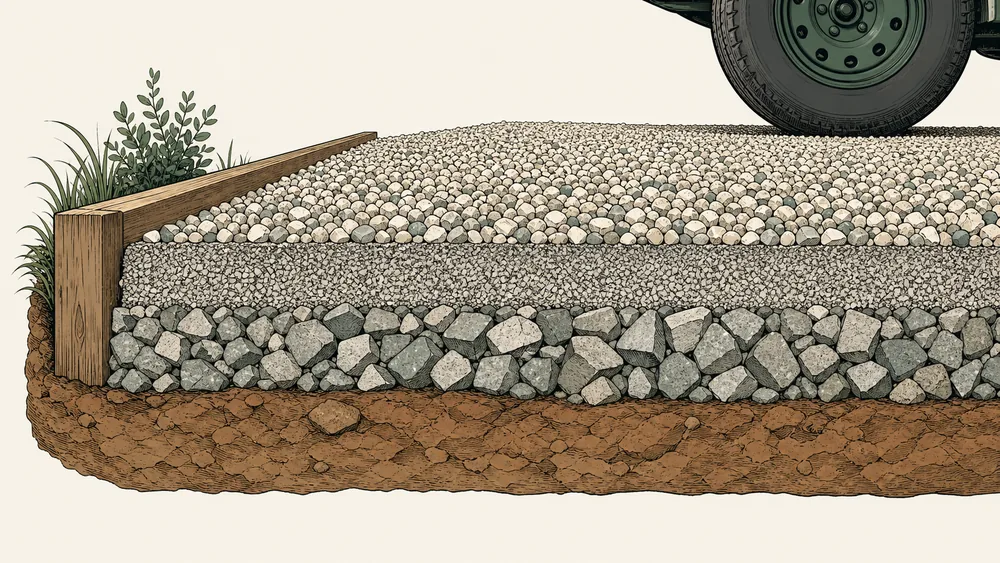
A compacted base course and a visible surface course can use different stone, density, compaction, and price. Combining them into one average layer hides the information needed for ordering and placement.
The gravel driveway calculator calculates both courses from the same measured footprint, then reports each tonnage, total volume, combined truckloads, and cost without merging the assumptions.
Use the gravel driveway calculator after the layer design is chosen, and carry both course names with the result so the base quantity cannot be mistaken for finished surfacing.
Measure every driveway section
For a drive with a wider apron, parking bay, or turnout, calculate each rectangle and total the areas. Do not apply the widest measurement to the entire length.
Truckloads are a delivery planning output
The calculator divides total buffered weight by an editable truck capacity. Road access, legal loads, scheduling, and supplier policy still need confirmation.


Reference data
Driveway layer and delivery reference
Use project-selected depths and supplier data; the values below only explain how the calculator separates the takeoff.
Layer inputs
compacted finished depth
The presets are not pavement design recommendations. Soil, frost, drainage, traffic, and local specifications determine appropriate construction.
Two-course calculation
visible from input to purchase
Verify base and surface depth, density, loose factor, price, and rounded delivery independently even though the result also reports a combined load.
Why it matters
One driveway, two purchase tickets
Compacted foundation
Uses a fines-rich density and a larger loose-volume factor.
Surface stone
Keeps its own depth, density, waste, and unit price.
Combined delivery
Truckloads are calculated from total buffered weight, not raw geometry.
Request separate line items when the base and surface products differ, and compare each quoted quantity with the copied assumptions.
Where it fits
Driveway layouts this model can support
Measure complex sites as multiple sections while preserving the two-layer calculation for every section.
Straight driveway
Use measured length and average finished width for a consistent run.
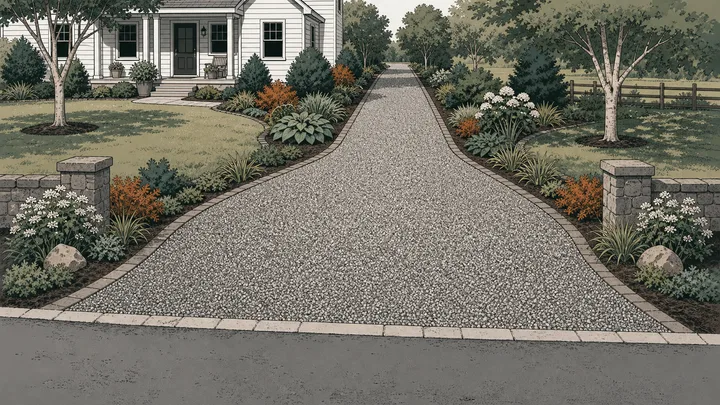
Wider entrance apron
Calculate the apron separately instead of applying its width to the whole drive.
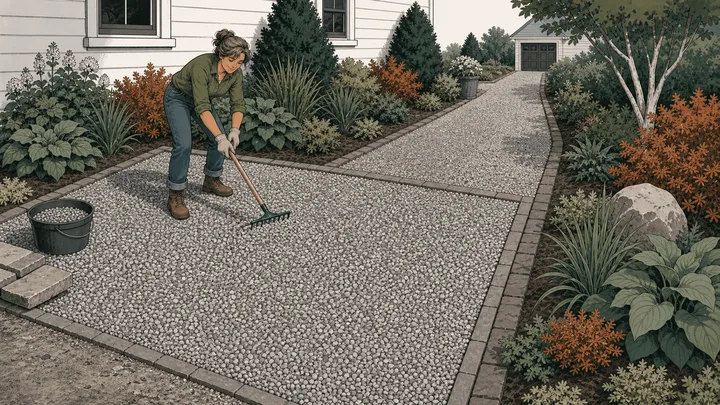
Parking extension
Add the parking rectangle to the main run while retaining common layer settings.

Surface refresh
Set the base depth to the project’s actual new work and avoid ordering untouched layers.
Method
Measure one driveway, calculate two material orders
The gravel driveway calculator applies the shared footprint to each selected course, converts them independently, and reports combined truckloads and cost without blending their assumptions.
Measure the full footprint
Add the drive, apron, and parking sections to get the area receiving each new course.
Define both courses
Choose base and surface products, compacted depths, densities, and loose-volume factors independently.
Plan orders and loads
Add extra material, round each product to its supplier increment, then estimate combined truckloads and cost.
Live worked example — waiting on your inputs
Calculate the driveway and the gravel driveway calculator will trace footprint, base volume, surface volume, both exact weights, both rounded orders, truckloads, and optional cost.
FAQ
Gravel driveway calculator questions about layers and loads
The gravel driveway calculator FAQ explains separate courses, circles and rings, compaction, truck capacity, pricing, and why structural design stays outside the result.
How much gravel do I need for a driveway?
Measure the driveway footprint and enter the selected compacted base and surface depths. The gravel driveway calculator reports both materials independently, adds extra material, rounds each order, and totals weight and truckloads.
Why are the base and surface calculated separately?
The two courses can use different products, bulk densities, compaction factors, depths, prices, and supplier increments. A combined average would make the purchase difficult to verify.
How many tons fit in a gravel truck?
Capacity depends on the vehicle, legal limits, material, and supplier. The tool starts with an editable 10-short-ton or 10-tonne planning capacity and rounds truckloads up; confirm delivery access and payload directly.
Can I estimate a gravel parking lot?
Yes for material quantity. Divide an irregular lot into measured rectangles or known areas and apply the selected layer depths. Traffic loading, drainage, grading, and pavement design remain outside this calculator.
Does the gravel driveway calculator include delivery cost?
Yes. Enter separate local material prices and a delivery charge. The calculation uses rounded supplier quantities; it does not invent local gravel prices, taxes, or trucking fees.
Calculation references and review
The gravel driveway calculator uses standard layer geometry, editable bulk densities, and explicit unit factors. FHWA gravel-road guidance is cited for material context; subgrade, drainage, crown, thickness, and traffic design remain user-supplied decisions.
- FHWA — Gravel Roads Construction & Maintenance Guide
- ASTM C29/C29M-23 — bulk density and voids in aggregate
- NIST SP 811 Appendix B.9 — conversion factors by quantity
Reviewed by the gravelcalculator.app editorial team on . Review scope: unique project logic, geometry, unit factors, bulk-density language, purchasing assumptions, interface labels, and calculation boundaries.