Choose how it arrives
Small bags, bulk bags or loose gravel?
Match the package to your access, storage and supplier’s quote.
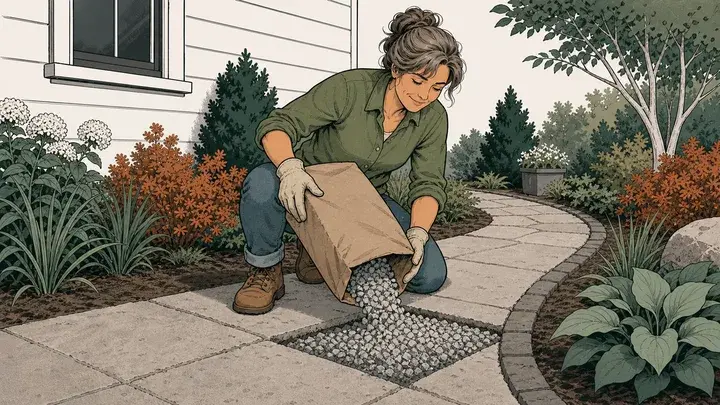
Small repairs
Small bags
Useful when you need a few sacks or must move material through a narrow route. Round up individual bags; check whether the seller allows split pallets.
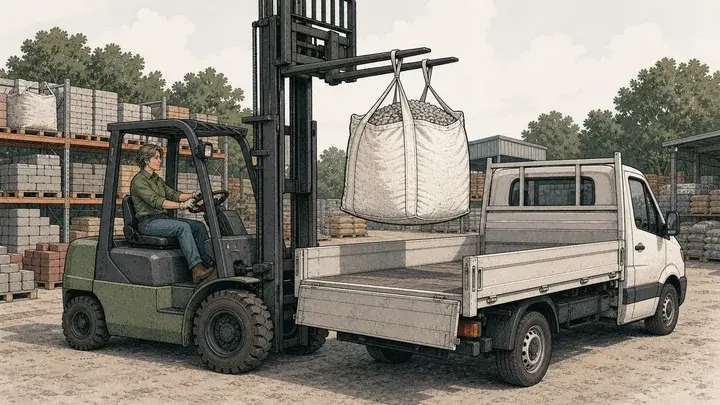
One contained delivery
Bulk bags
Check the labelled contents and unloading access. An 800 kg bag is not one cubic metre: at the example density, it contains 0.5 m³.
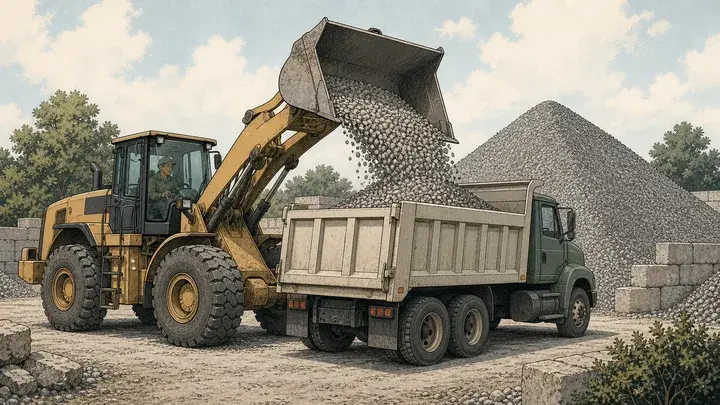
Room for a tipped load
Loose delivery
Compare the delivered total, not just the material rate. Ask about minimum loads, billing increments and a suitable place to tip the gravel.
Read the label
Weight bags need density. Volume bags do not.
A 20 kg sack tells you mass. To find the space it fills, divide by the supplier’s loose bulk density. A 25-litre sack already states volume: 0.025 m³.
The gravel bag calculator handles both labels. Changing density affects weight-labelled bag counts; it does not change the count for volume-labelled bags.
Why loose bulk density matters
Bulk density includes gaps between particles. It differs from solid-rock density and varies with grading, moisture and packing. The default 1,600 kg/m³ is an editable example, not a product specification.
Already allowed for compaction?
Enter the loose purchase volume from your project takeoff. This tool does not choose a structural depth or compaction factor. Do not add an allowance here if it is already included in that volume.
The calculation, in three steps
Volume → contents → whole bags
- 01Measure the fill
Area × depth × (1 + allowance ÷ 100)
- 02Convert one bag
Weight in kg ÷ density in kg/m³
Or use its labelled volume directly - 03Round the purchase up
Required volume ÷ bag volume
Round to the next whole bag
For full pallets, divide the small-bag count by bags per pallet, then round upward again.
Worked example
A 10 m² bed, 5 cm deep
Zero allowance · 1,600 kg/m³ example density
A 60-bag pallet buys 20 extra sacks. Compare its quote against 40 individual bags before choosing. Change the calculator inputs to see your own calculation.
Avoid over-ordering
Three checks before checkout
Use the actual fill area
Exclude paving and planting gaps. Split an irregular bed into simple shapes and add their areas before entering the total.
Check the coverage depth
A 25-litre bag covers 0.5 m² at 50 mm depth. Double the depth and coverage halves. Match any advertised coverage to your layer depth.
Price the purchased quantity
Bag costs use rounded counts. Pallet costs assume the same per-bag rate; replace the comparison with a supplier quote if a discount applies.
Quick answers
Bag-order questions
How many bags of gravel do I need?
Divide the required loose volume by one bag’s volume and round up. For weight-labelled bags, convert weight to volume using bulk density first. This gravel bag calculator applies your allowance before rounding.
Can I mix small bags and bulk bags?
The results are alternatives, not a mixed-order optimizer. Subtract the volume of your chosen bulk bags from the requirement, then calculate small bags for any positive remainder.
Why does a little extra need another bag?
A requirement just above one package needs two whole packages. Open “Surplus & calculation” to see the overbuy, then ask about smaller bags or a loose top-up.
Are taxes and delivery included?
Delivery is included when you enter a charge. Taxes, deposits, pallet discounts and loose-load minimums are excluded. Blank prices stay unquoted; enter zero only for an actual zero-cost item.
Sources and review
Conversions follow NIST’s unit tables. Package sizes, prices and density are user inputs; the examples are illustrative. Site illustrations show purchase scenarios, not specific products or loading instructions.
Reviewed by the gravelcalculator.app editorial team on . Scope: unit conversion, package rounding, cost arithmetic and purchasing limitations.