Plan the material
Keep the stone specification with the quantity
The #57 name identifies a grading; it does not supply one universal mass per cubic yard.
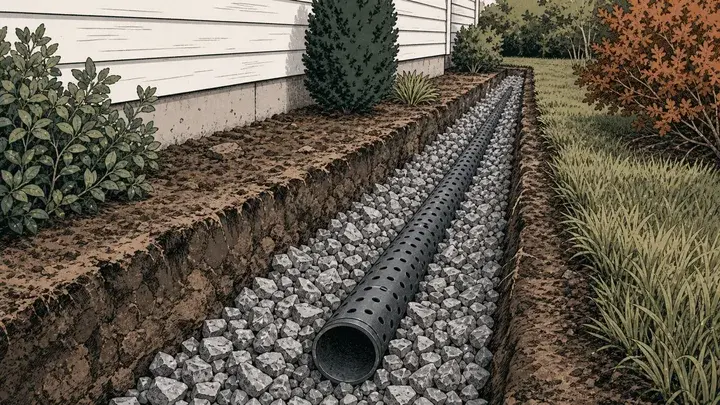
Drainage aggregate
Order the grading and cleanliness required by the drainage detail. A volume estimate describes the space to fill, while the design decides which stone belongs there. Check whether pipes or other components displace part of that volume.

A specified driveway layer
Measure the particular layer that calls for #57 stone. Keep other base and surface materials separate. The calculator does not decide whether a single stone layer is suitable for the ground, loading or finish you need.
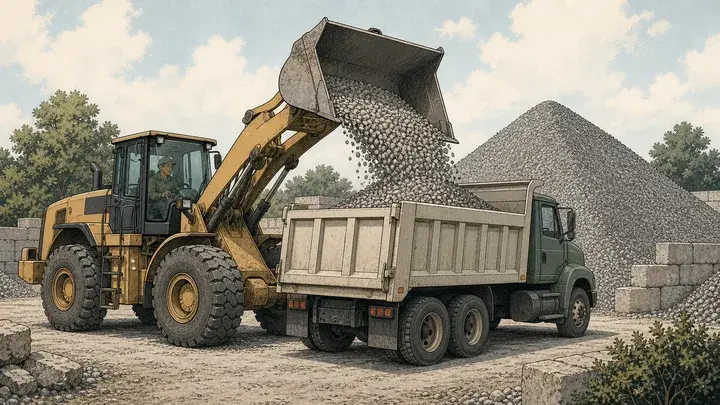
A supplier-ready order
Take both the cubic volume and the selected weight estimate to the supplier. Replace the example density range with product data. Round in the unit the seller actually bills, rather than rounding independently in every displayed unit.
Know the assumptions
Volume is fixed; weight follows bulk density
The 57 stone calculator first multiplies footprint by thickness and adds any extra-material allowance. That establishes the loose stone volume. The selected density produces the central weight, while the low and high values show how much the mass changes across your chosen range.
The opening range of 1,400–1,800 kg/m³ is an illustrative sensitivity band around 1,600 kg/m³, not a certified #57 range. A quarry’s material, moisture and handling can fall outside it. Change the bounds and selected value together when you have supplier information.
What does the #57 designation tell me?
It refers to an aggregate size designation, not a fixed density or a complete installation specification. Request the supplier’s grading and project acceptance information rather than treating the label as a guarantee of suitability.
Why show a range before rounding?
A small density change can push the requirement into the next supplier increment. The low and high weights describe unrounded requirements; the main order uses your selected density and chosen purchase unit.
The calculation, in three steps
From your inputs to the estimate
- 01Find the stone volume
Loose m³ = area × depth × (1 + extra material ÷ 100).
- 02Compare density assumptions
Low and high weights = the same volume × each bulk-density bound.
- 03Round one purchase unit
Convert the selected estimate to the quoted unit, then round up to its increment.
Worked example
One cubic metre, three possible weights
20 m² × 50 mm · zero extra stone · illustrative densities
The selected 1,600 kg/m³ estimate rounds to 2 US tons when the supplier sells in half-ton increments. The volume is still 1 m³, or about 1.308 yd³. These are alternative units for the same requirement, not amounts to add together.
Before you order
Check the specification before ordering #57
Use bulk density
Density of solid rock excludes air gaps and is not the same as a loose load. Ask for a delivery conversion or bulk-density value for the actual product.
Match the specified layer
Do not substitute clean stone for a graded base solely because the calculated weight is similar. Material selection and layer depth come from the project detail.
Keep extra separate from compaction
Extra stone here is a simple purchasing allowance. If a finished-to-loose conversion is required, make that adjustment explicitly rather than assuming the percentage supplies it.
Quick answers
#57 stone ordering questions
How many tons of #57 stone are in a cubic yard?
The conversion depends on loose bulk density and the meaning of ton. At the example 1,600 kg/m³, one cubic yard weighs about 1.348 US short tons. Replace that example with the supplier’s product conversion.
How much area does one ton of #57 cover?
At 1,600 kg/m³ and 2 inches deep, one US short ton covers about 120.14 sq ft before losses. A deeper layer covers less. The result panel recalculates this coverage for your selected depth and density.
Can I order in cubic yards instead of tons?
Yes. Select cubic yards and enter the supplier’s yard increment. The rounded volume order does not depend on density, although the weight range remains useful when discussing truck loading.
Does #57 stone need the same allowance as crusher run?
Do not assume so. Their grading and placement requirements can differ. This tool leaves extra material at zero until you provide an allowance, and it does not apply an automatic compaction factor.
Sources and review
FHWA identifies 57 as an aggregate size designation; NIST supports volume and mass conversions. The density band is an explicitly labelled example rather than a sourced material specification. Illustrations depict project contexts and are not samples certifying a particular #57 product.
- NIST SP 811 — area, volume and mass conversions
- FHWA-HRT-13-024, page 2 — aggregate size designations
Reviewed by the gravelcalculator.app editorial team on . Scope: calculation assumptions, unit conversions, rounding and material-estimate boundaries.