Plan the material
Start with what is on the ticket
A stockpile, a weighed load and a stack of bags all reach the same calculation through different units.
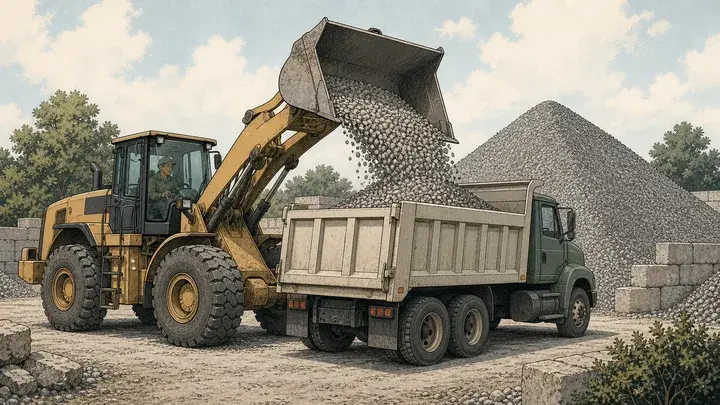
A load measured by volume
Use cubic yards or cubic metres exactly as quoted. Volume already includes the spaces between stones, so density does not change the ground area. Avoid using the outside dimensions of a partly filled truck.
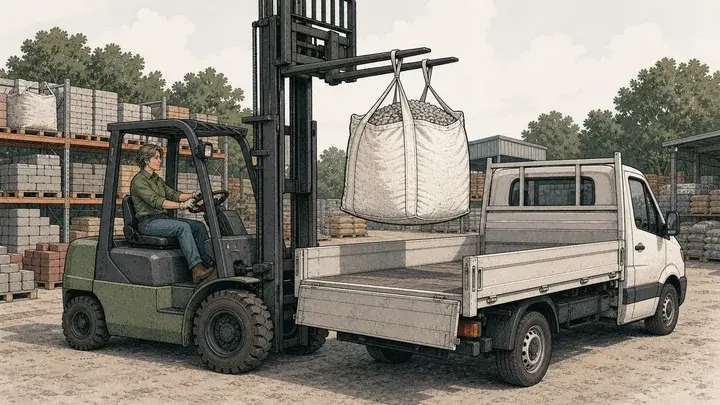
A load measured by weight
Tonnes and US short tons have different masses. Read the delivery ticket, choose the matching unit and enter the loose bulk density. A bag described only as “bulk” needs its actual contents confirmed.
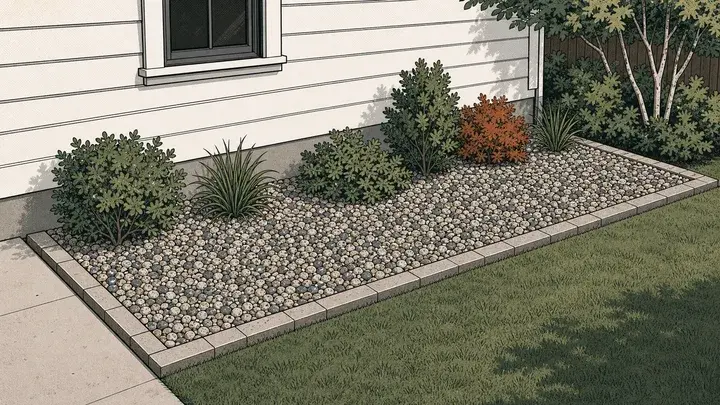
A bed with a fixed depth
Spread depth determines how far the stock will go. Keep material for uneven spots if necessary. Existing paving, plant openings and areas outside the edging should not be counted as gravel-covered ground.
Know the assumptions
Known volume divided by depth gives area
The gravel coverage calculator works backward from an available quantity. One cubic metre spread 0.05 m deep covers 20 m². At 0.10 m deep, the same material covers 10 m². No additional material appears when you change the shape of the bed.
Weight-labelled stock first becomes volume: kilograms divided by loose bulk density in kg/m³. For bags, multiply the number of bags by each bag’s labelled volume, or convert each bag’s weight. The reserve is then removed before calculating coverage.
Why do 10 mm and 20 mm gravel differ?
Particle size is not the spreading depth. Grading can also change bulk density. Enter the product’s density and the intended layer thickness independently rather than treating the stone size as a coverage rate.
How should I use a material reserve?
A 10% reserve leaves 90% of the stock available for the planned area. This is a deduction from existing material, unlike adding 10% to a new purchase quantity.
The calculation, in three steps
From your inputs to the estimate
- 01Express the stock as loose volume
Weight ÷ bulk density, or bag count × volume per bag.
- 02Remove the held-back material
Usable volume = stock volume × (1 − reserve ÷ 100).
- 03Divide by spreading depth
Area in m² = usable m³ ÷ depth in metres.
Worked example
One cubic metre at 50 mm
Illustrative loose layer · no compaction · zero reserve
Holding back 10% reduces the result to 18 m². Twenty 25-litre bags contain 0.5 m³ and cover 10 m² at this depth. These examples assume the labelled volume is usable material, not the packaging volume.
Before you order
Make the coverage work on the ground
Keep depth consistent
A deeper strip near an edge consumes stock faster than the flat-area estimate. Measure several points when the underlying surface is uneven.
Match the bag label
Twenty kilograms and twenty litres are not interchangeable. At the example density, a 20 kg sack holds 12.5 litres.
Separate compacted work
Coverage here is a loose spread. For a specified compacted base, first account for volume reduction using the compaction tool.
Quick answers
Coverage questions
How much area does one ton of gravel cover?
It depends on which ton, the density and the depth. At 1,600 kg/m³ and 50 mm depth, one US short ton covers about 11.34 m², or 122.06 sq ft. A metric tonne covers 12.5 m² under the same assumptions.
How much does one cubic yard cover?
One cubic yard contains 27 cubic feet. At 3 inches deep, divide 27 by 0.25 feet: the coverage is 108 square feet before any reserve. Changing density does not alter this volume-based answer.
Can I calculate bulk bag coverage?
Yes. Select whole bags and enter the actual kg, lb or volume per bag. Do not assume every bulk bag is one tonne or one cubic metre; packaging labels and suppliers differ.
What if I know the area but not the quantity?
Use the main gravel calculator to turn the project dimensions into an amount to buy. This page is for the opposite question: how far an existing quantity will go.
Sources and review
Area follows the volume-to-depth identity; NIST supplies the unit conversions. Density and reserve are editable assumptions, and the examples describe uniform loose layers. Illustrations show measurement and delivery scenarios, not specific products.
Reviewed by the gravelcalculator.app editorial team on . Scope: calculation assumptions, unit conversions, rounding and material-estimate boundaries.